
Industry Insights
Expanding Your Bag Line: When to Add New Categories and When to Stay Focused
Every successful bag brand faces the expansion question: add backpacks to your tote line? Add luggage to your backpack line? The framework for deciding when to expand and when to double down.
Every successful bag brand faces the expansion question: add backpacks to your tote line? Add luggage to your backpack line? Add a crossbody to your shoulder bag family? The expansion question is a strategy question disguised as a product question — and the brands that answer it well grow sustainably, while the brands that answer it poorly dilute their identity and their inventory. Here is the framework for deciding when to expand a bag line and when to double down on what already works.
The Signal: Three Indicators That Expansion Is Due
Line expansion is driven by demand signals, not by product catalogs. Three indicators that a category expansion is due:
1. Customer overlap. Buyers of your existing line are asking for the new category — in reviews, in customer service emails, in repeat-purchase conversations. If your tote buyers ask "do you make a backpack?" that is a demand signal, not a suggestion.
2. Production readiness. Your existing factory or development partner can produce the new category — or you have identified a specialist who can. Expansion into a category your supply chain cannot serve is a inventory risk, not a growth opportunity.
3. Design language portability. Your brand's design language — the materials, the hardware finish, the color palette — transfers naturally to the new category. A heritage canvas brand expanding into technical nylon backpacks is stretching; a heritage canvas brand expanding into canvas crossbodies is extending.
All three indicators together = expand. One or two = prepare (sample the category, test with your audience, and expand when the third signal confirms). None = double down on what works.
The Expansion Sequence: How to Add a Category
Category expansion follows the same development pipeline as the first category — with two differences: the design language is already defined, and the customer base already exists. The sequence:
Stage | What Happens | What's Different from First Launch |
|---|---|---|
Spec sheet | Same format, new category | The design language constraints are already written |
Factory matching | Same cluster, potentially different specialist | The new category may need a different factory than your existing line |
Sampling | Same discipline, new construction type | The sample review criteria are category-specific |
Launch | To your existing customer base first | The audience is warm — no cold-start marketing needed |
The last stage is the expansion's advantage: your existing customers are the launch audience. A tote brand launching backpacks announces the backpack to the tote buyer list — and the conversion rate is higher than any cold acquisition channel.
The Anti-Pattern: Expansion Without Focus
The most common expansion failure: adding categories because the factory can make them, not because the market demands them. The symptoms:
A bag line with twelve categories and no best-seller in any of them
Inventory spread thin across categories, with every SKU at minimum stock
A brand identity that customers cannot describe in one sentence
Development resources spread across categories instead of deepening the core
The antidote: the 80/20 rule. 80% of development resources on the core category (where the brand's identity lives), 20% on the expansion category (where the growth lives). The ratio shifts as the expansion category proves itself — but the core never drops below 50%.
The Design Language Test
Before expanding into a new category, apply the design language test: can a customer identify your brand's bag in the new category without seeing the logo?
The test: place your existing best-seller next to the new category's sample. Do they share the same material family, the same hardware finish, the same color palette, the same stitching density? If yes, the expansion extends the brand. If no, the expansion creates a second brand inside the first — and the customer confusion costs more than the new category earns.
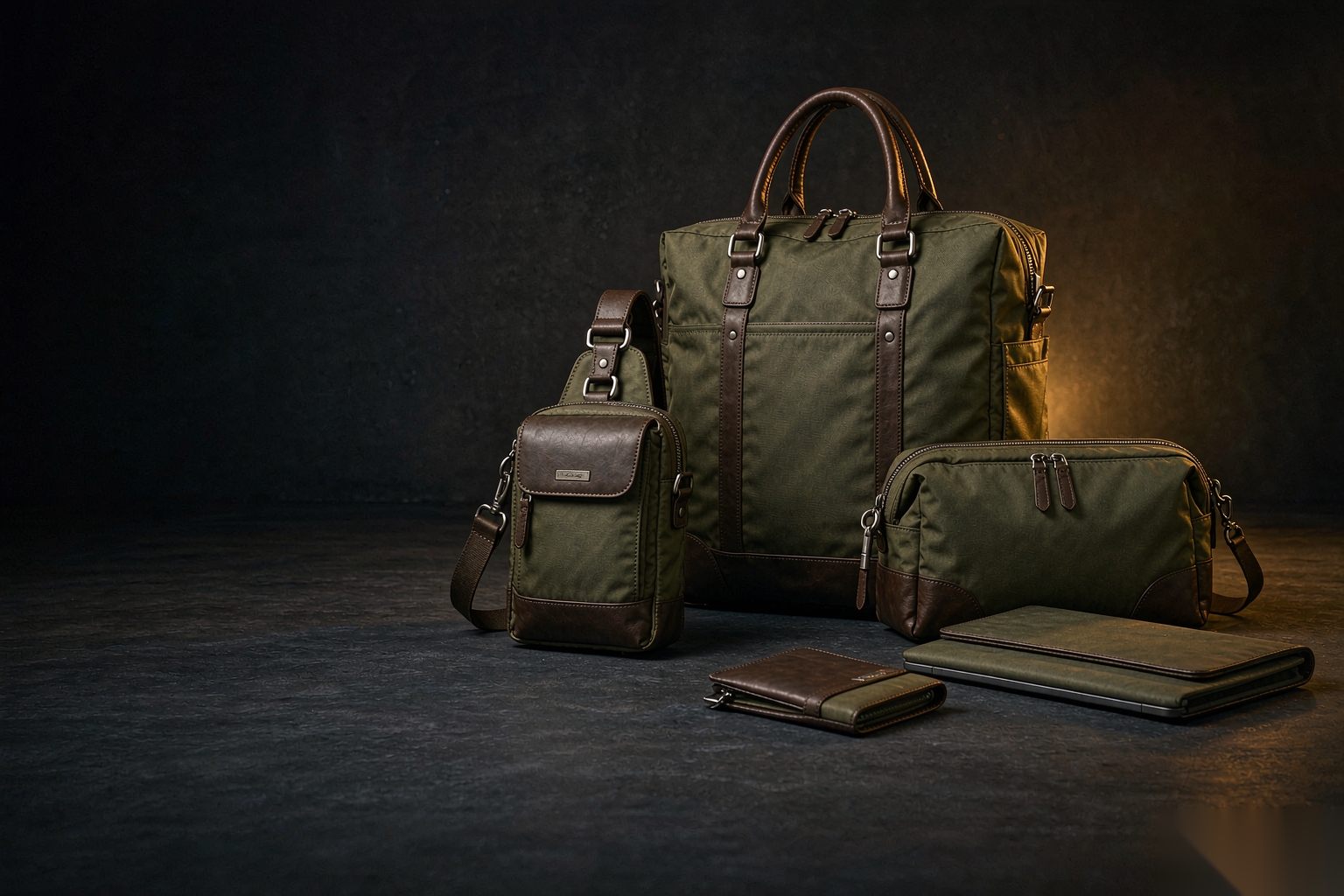
Our heritage luggage collection demonstrates the test: olive canvas, leather trim, and gunmetal hardware held consistent from spinners to backpacks to travel wallets. A customer who buys the spinner recognizes the backpack as the same brand — without reading the label.
The Production Reality: Category-Specific Factories
Bag production is category-specialized. A factory that excels at soft nylon totes may not produce structured leather briefcases. A factory that makes hiking backpacks with frames may not produce delicate clutches. The expansion's production reality:
Same factory expansion: possible when the new category uses the same construction type and materials. A tote factory expanding into crossbodies is a natural extension.
New factory required: when the new category uses different construction. A tote factory expanding into hiking backpacks with frames requires a factory with frame-bending and suspension-sewing capability.
The multi-factory expansion adds a coordination layer: two factories, two QC standards, two production calendars, one brand. A development partner manages this coordination — our development process handles multi-category programs across the Quanzhou cluster's specialist factories.
MOQs depend on the product and factory. Tell us what you need and we confirm what is realistic before you commit to anything. New category MOQs are typically higher than expansion MOQs in existing categories — the factory is learning a new construction type, and the learning curve is priced in.
Frequently Asked Questions
How many categories should a bag brand have?
There is no magic number — but there is a clarity test: can you describe your brand in one sentence that includes every category? "We make heritage-style travel bags" covers spinners, duffels, and backpacks. "We make bags" covers everything and nothing.
Should I launch a new category with a full line or a single product?
A single product — one hero piece in the new category, launched to your existing customer base. If it sells, expand the category in the next season. A full-line launch into an unproven category is an inventory risk.
Can I use different factories for different categories?
Yes, and most multi-category brands do. The design language unifies the brand; the factories specialize by construction type. The development partner manages the coordination.
The Takeaway
Bag line expansion is a demand-driven decision: expand when the customer overlap, the production readiness, and the design language portability all align. Double down when they don't. The brands that expand deliberately — one category at a time, launched to a warm audience — grow sustainably. The brands that expand because the factory can make it — dilute.
